The application and difference between EPON and GPON
Today, let's take a look at the difference between EPON and GPON
About PON
What is PON
PON (passive optical network) technology (including EPON, GPON) is the main implementation technology for the development of FTTx (fiber-to-the-home), which can save backbone fiber resources and network levels, and can provide bidirectional high bandwidth under long-distance transmission conditions. There are various types of access services, and its remote management capabilities and passive optical distribution network structure can greatly reduce operation and maintenance costs, and can support a variety of application scenarios.
PON technology development
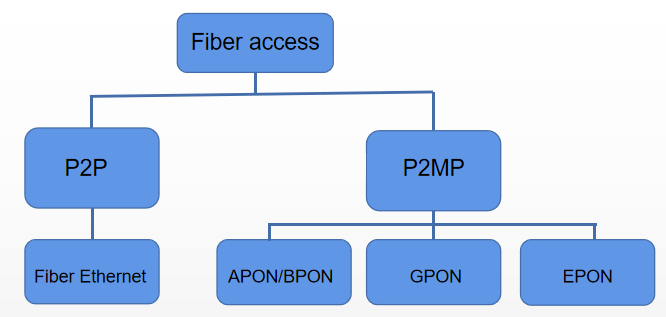
After years of development, PON has formed a series of products such as APON, BPON, EPON, and GPON.
APON(ATMPON)
ATM is a cell-based transfer Protocol. 155Mb/s PON system technical specification, ITU-TG.983 series of standards;
BPON(BroadbandPON)
The APON standard was later strengthened to support a transmission rate of 622Mb/s, and at the same time added functions such as dynamic bandwidth allocation and protection
EPON(Ethernet PON)
GPON(GigabitPON)
Fiber Access Technology
About EPON
EPON (Ethernet Passive Optical Network) is a point-to-multipoint network structure, passive optical fiber transmission method, based on high-speed Ethernet platform and TDM (time division multiplexing) time division MAC media access control method, providing multiple integrated service broadband access technology.
The EPON system adopts WDM technology to realize single-fiber bidirectional transmission.
The principle of EPON
In order to separate the signals of the coming and going directions of multiple users on the same fiber, the following two multiplexing techniques are used.
a. The downlink data stream adopts broadcast technology.
b. Upstream data stream adopts TDMA technology
The principle of EPON - downlink
a. A unique LLID is allocated after the ONU is successfully registered.
b. Add an LLID before the start of each grouping, replacing the last two bytes of the Ethernet preamble.
c. When the OLT receives data, it compares the LLID registration list. When the ONU receives data, it only receives frames or broadcast frames that match its own LLID.
The principle of EPON - upstream
a. The OLT compares the LLID registration list before receiving the data.
b. Each ONU sends data frames in the time slot uniformly allocated by the central office equipment
c. The allocated time slot compensates for the distance difference between the ONUs and avoids collisions between the ONUs.
EPON system working process
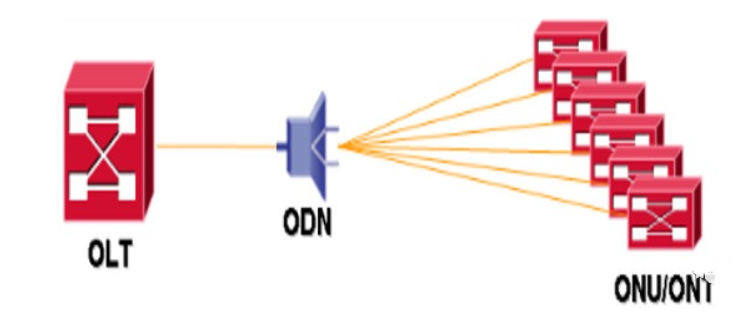
Operation of OLT
a. A time message is generated for the system to reference the time.
b. Assign bandwidth through MPCP frame 3. Perform ranging operation.
c. Controls ONU registration.
Operation of the ONU
a. The ONU synchronizes with the OLT through the time stamp of the downstream control frame.
b. ONU waits to find frame
c. The ONU performs discovery processing, including: ranging, specifying physical ID and bandwidth.
d. ONU waits for authorization, ONU can only send data at authorized time
Design of EPON Network Management System
EPON network management system is divided into four modules according to network management functions: configuration management, performance management, fault management and safety management.
Realization of EPON Network Management System
a. The realization of the EPON network management system includes the realization of the management station network management software and the realization of the agent station software.
b. The management station network management system is to provide users with a friendly interactive interface, and use the SNMP protocol to control the agent process.
c. The main work of SNMP in the agent station is the realization of agent process software and the design of MIB.
About GPON
What’s GPON?
GPON (Gigabit-CapablePON Gigabit Passive Optical Network) technology is the latest generation broadband passive optical integrated access standard based on ITU-TG.984.x (ITU TG.984.x) standard, with high bandwidth, High efficiency, large coverage, rich user interface and many other advantages are regarded by most operators as an ideal technology for realizing broadband and comprehensive transformation of access network services.
Principle of GPON
GPON Downlink - Broadcast Transmission
GPONS upstream - TDMA mode
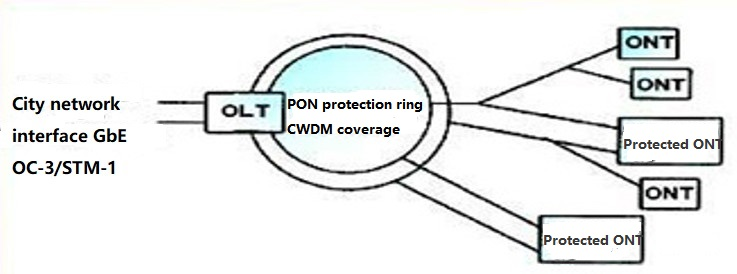
The network topology structure of passive optical fiber transmission mode is mainly composed of OLT (optical line terminal), ODN (optical fiber distribution network), and ONU (optical network unit).
ODN provides optical transmission means for OLT and ONU. It consists of passive optical splitter and passive optical combiner. It is a passive device connecting OLT and ONU.
GPON principle - uplink

a. The transmission of uplink data is uniformly controlled by the OLT.
b. The ONU transmits user data according to the time slot allocated by the OLT, so as to avoid data transmission conflicts generated by the ONU.
c. The ONU inserts uplink data in its own time slot according to the time slot allocation frame, which realizes the sharing of uplink channel bandwidth among multiple ONUs.
GPON networking mode
GPON mainly adopts three kinds of networking methods: FTTH/O, FTTB+LAN and FTTB+DSL.
a. FTTH/O is fiber to the home/office. The optical fiber is directly connected to the user's ONU after passing through the optical splitter. If the ONU is only used by one user, the bandwidth is high and the cost is higher. Generally, it is aimed at high-end users and commercial users.
b. FTTB+LAN is fiber-to-the-building, and then different services are connected to multiple users through a large-capacity ONU (called MDU), so multiple users share the bandwidth resources of one ONU, each person occupies less bandwidth, and the cost is also lower. The groups are generally low-end residential and commercial users.
c. FTTB+ADSL is fiber-to-the-building, and then uses ADSL to access services to multiple users, and multiple users share one ONU. The bandwidth, cost, and customer base are similar to FTTB+LAN’s.
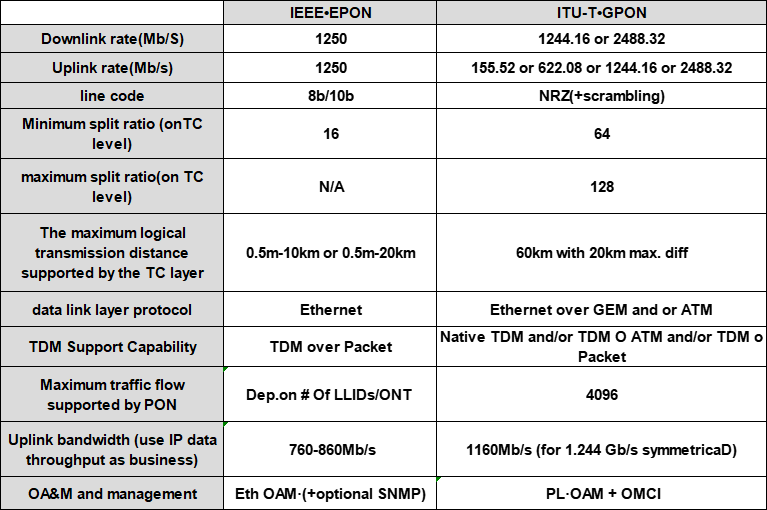
Comparison of GPON and EPON Technology
a. GPON supports a variety of rate grades, and can support asymmetric rates of upstream and downstream. GPON has greater redundancy in the selection of optical components, so to save costs.
b. EPON only supports ODN levels of Class A and B, while GPON can support Class A, B and C, so GPON can support a split ratio of up to 128 and a transmission distance of up to 20km.
c. The EPON standard is based on the 802.3 architecture, so it is simpler than the GPON standard protocol and easier to implement the system.
d. ITU has used many concepts of APON standard G.983 in the process of formulating GPON standard. Compared with EPON standard formulated by EFM, GPON standard is more complete. Prescribing a high-efficiency TC layer mechanism will become a key for ITU to formulate GPON standards.
5. The GPON standard stipulates that the TC sublayer can adopt two encapsulation methods, ATM and GFP, among which the GFP encapsulation method is suitable for carrying IP/PPP and other packet-based high-level protocols.
Toputel technology found in 2014, as an experienced expert we support our customers and partners with communication access devices, IoT cloud management platform and services in IoT and M2M industry. Welcome your inquiry.