Blogs

7 core properties of 5G industrial routers

Views : 5401
Author : Ava
Update time : 2022-04-01 15:12:45

7 core properties of 5G industrial routers


Industrial router is a kind of wireless data transmission function that utilizes public wireless network to provide users with wireless data transmission. How to choose a good 5G industrial router? What performance does a good 5G industrial router have? Let's take a look at the 7 core properties of a 5G industrial router.
 
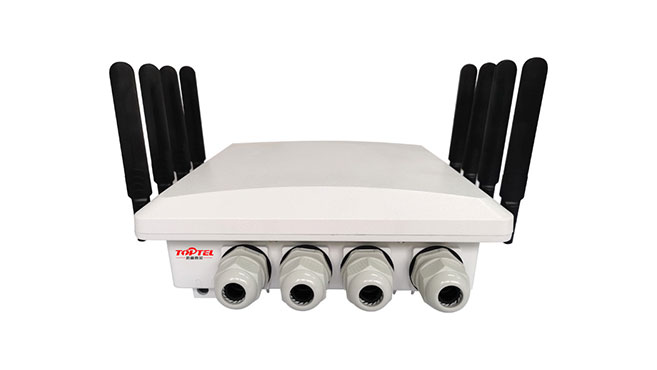
Toputel RG5000-OD Quad Ethernet IP66 Outdoor 5G PoE Gateway

1. Throughput
Throughput is the packet forwarding capability of the core router. Throughput is related to the number of router ports, port rate, packet length, packet type, routing calculation mode (distributed or centralized), and test method, and generally refers to the ability of the processor to process packets. The packet forwarding capability of the high-speed router is at least 20Mpps. Throughput mainly includes two aspects:

a. The throughput of the whole machine. 
The packet forwarding capability of the device is an important indicator of device performance. The job of 5G industrial routers is to select routes based on IP headers or MPLS labels, so the performance indicator refers to the number of forwarded packets per second. The throughput of the whole machine is usually less than the sum of the throughput of all ports of the core router.

b. Port throughput
Port throughput refers to the port packet forwarding capability, which is the packet forwarding capability of the core router on a certain port. Usually two test interfaces at the same rate are used. Generally, the test interface may be related to the position and relationship of the interface. For example, the test throughput between ports on the same card may be different from the throughput value between ports on different cards.


 2. Routing Table Capability
Routers usually rely on established and maintained routing tables to determine packet forwarding. The 5G industrial routing table capability refers to the limit of the number of routing table
 entries  contained in the routing table. Since the core routers that implement the BGP protocol on the Internet usually have hundreds of thousands of routing table entries, this item is also an important manifestation of router capabilities. In general, a high-speed core router should be able to support at least 250,000 routes, providing at least 2 paths per destination address on average, and the system must support at least 25 BGP peers and at least 50 IGP neighbors.

3. Backplane Capability

Backplane refers to the physical path between input and output ports. The backplane capability is the internal implementation of the core router. The traditional core router uses a shared backplane, but as a high-performance router, it will inevitably encounter congestion problems. Secondly, it is difficult to design a high-speed shared buses. Therefore, the existing high-speed core routers generally use Swappable backplane design. The backplane capability can be reflected in the router throughput, and the backplane capability is usually greater than the value calculated based on the throughput and the test packet length. However, the backplane capability can only be reflected in the design, and generally cannot be tested.

4. Back-to-Back Frames
The number of back-to-back frames refers to the number of packets when the most packets are sent at the min frame interval without causing packet loss. This metric is used to test the core router caching capability. For a core router with wire-speed full-duplex forwarding capability, the value of this indicator is infinite.


5. Packet loss rate
The packet loss rate refers to the proportion of data packets that cannot be forwarded due to lack of resources in the core router under a stable and continuous load in the data packets that should be forwarded. The packet loss rate is usually used as a measure of the performance of the core router when the router is overloaded. The packet loss rate is related to the length of the data packet and the frequency of packet transmission. In some environments, the test simulation can be performed after adding routing jitter or a large number of routes.


6. Latency
 Latency refers to the time interval from the first bit of the data packet entering the router to the last bit being output from the core router. This time interval is the processing time of the core router operating in the store-and-forward mode. Latency is related to both packet length and link rate, and is usually tested within the router port throughput range. Delay has a great impact on network performance. As a high-speed router, in the worst case, the delay for IP packets of 1518 bytes and below is required to be less than 1ms.


7. Delay jitter
Delay jitter refers to delay variation. Data services are not sensitive to delay jitter, so this indicator is usually an important indicator for measuring high-speed core routers. For IP services other than data, such as voice and video services, this indicator is necessary to test.


Successful Case

Intelligent Healthcare
Difficult and expensive to see a doctor, overcrowding in large hospitals, no one in community hospitals, cumbersome procedures, medical resources polarization, these problems have become an important factor affecting .....
Intelligent Bus Station
Being part of intelligent transport and smart city, smart bus station platform is a livelihood project benefit cctizen's daily life. an implement task. Electronic station boards at the bus stations display public vehicles arrival information and operation state in real time......
Intelligent Charging Pile
Charging facilities mainly includes centralized charging station and distributed changing piles, scattered location and large number. In order to ensure user experience and operation efficiency, it is necessary to provide......
Smart Logistics and Smart Warehouse
With the coming 5G era, core technologies such as artificial intelligence, big data and cloud computing, IoT and blockchain etc., can be quickly implemented to serve the new generation of logistics.  Along with the development of factory......
Secondary Water Supply Control
With the progress of urbanization, the current decentralized management mode of secondary water supply has been unable to meet the requirements for secondary water supply management, water quality and pressure, and service quality......
Intelligent distributed feeder automation
The smart power grid is moving toward intelligent distributed feeder automation (FA) to provide power supply stability, fast response to outages, running topology calculations, and fast fault location and isolation. Energy network must realize......
Intelligent Elevator
In recent years, elevator accident happens time by time. there are two main factors for this situation: 1. the lack of regular maintenance, 2,people know less about the principle of elevator construction......
Industrial Manufacturing
industrial automation technology is a comprehensive high technology intergrating control ttheory, instruments and meters, edge computering and real-time communcation technology to realize detection, control and......
Meteorological Monitoring
The ground network of the traditional meteorological information system is built earlier, and the equipment performance is not good enough, the line speed is low, and the time is prolonged. It is difficult to meet the comprehensive data transmission requirements of automatic stations, sandstorms, radar etc.Satellite network coverage is small, low speed, and small stations can not directly communicate with each other, which limits the network function.
Remote Monitoring for Wind Farm
In order to guarantee the normal operation of the wind turbines, expect to implement preventive maintenance to significantly reducing the fan fault losses, and realize the efficient and reliable equipment data transmission via Ethernet......
Mobile WIFI
With the development of wireless communication industry, WiFi communication is gradually promoted to public places, including public mobile transportation vehicles, such as buses, tour bus, subway, cruise ship etc.......
Digital Signage(billboard)
​​​​​​​In the era of rapid economic development, marketing and promotion are becoming increasingly hot, and outdoor advertising is increasing. However, the traditinoal management  is chaotic and low efficiency , lacks of scientific characteristics......
Message Us