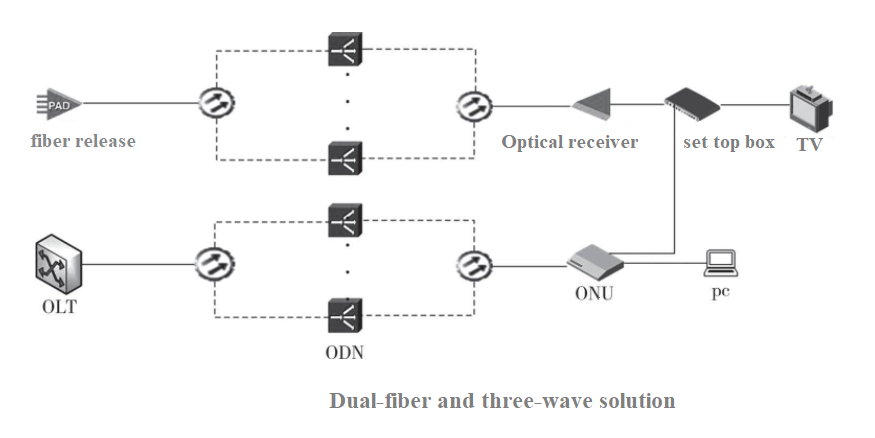
RF Overlay as a wired FTTH implementation technology, RF Overlay transmits radio and television services through radio frequency and carries broadband access services through baseband digital. It modulates broadband access services and radio and television services to different optical transmission channels respectively. Cable FTTH can be divided into Optical Broadcast Television Network (OBN) and Optical IP Data Network (OIN). Among them, the optical broadcast transmission platform in the optical broadcast TV network is composed of an optical transmitter and an optical fiber amplifier, and the terminal is an optical receiver; the data transmission platform in the optical IP data network is an optical line terminal (OLT), and the terminal is an optical network unit ( ONU)
There are two types of RF Overlay technology networking solutions, namely dual-fiber three-wave networking and single-fiber three-wave networking. The dual-fiber three-wave networking scheme refers to the transmission of data signals in one optical fiber, and the transmission of radio and television signals in the other optical fiber. The single-fiber three-wave networking scheme refers to the transmission of data signals and radio and television signals in the same optical fiber. The dual-fiber and three-wave networking technology solution of RF Overlay, the optical receiver and ONU are detachable modules or devices, which are more suitable for the scenarios where the deployment of broadcast TV services and broadband access services is not synchronized.
In the RF Overlay networking solution, FTTH can achieve bandwidth upgrade by reducing the optical splitting ratio or upgrading the PON system. In the process of upgrading the EPON system to the 10G EPON system, the OLT of 10G EPON can be compatible with ONU of EPON. When the OLT of 10G EPON is compatible with EPON ONU, part of the performance of the corresponding port needs to be sacrificed.
The RF Overlay technology networking solution adopts the PON+HINOC, PON+C-DOCSIS and PON+C-HPAV technology solutions to realize the two-way access cable TV network. With the increase of bandwidth demand, it gradually transitions to FTTH, villa areas, remote rural areas, etc. Signals are transmitted over a long distance, and long-distance transmission is realized by means of PON technology under the condition that the transmission link has no power supply.
Single fiber three waves
In the RF Overlay single-fiber three-wave networking solution, the OLT multiplexes the downlink data transmission wavelength of the PON and the radio and television optical transmission wavelength through an optical multiplexer/wavelength division multiplexing. At the same time, the upstream data transmission wavelength of the PON is separated in the upstream direction. After the ONU separates the PON downlink data transmission wavelength and the broadcast TV optical transmission wavelength, it is provided to the set-top box, the TV with built-in set-top box modules, PC terminals, integrated home gateways or terminals through the Ethernet interface and the RF interface respectively.
The advantage of the single-fiber three-wave solution is that it is a common main fiber, thereby saving fiber resources. In order to ensure that the radio and television signals and data signals do not interfere with each other, the isolation of the wavelength division multiplexing/optical demultiplexer must reach more than 35dB. And when designing the wired FTTH network, pay attention to the optical power ratio of the PON data light wave and the radio frequency TV light wave to reduce the crosstalk between wavelengths