Blogs

The relationship between access layer switches, aggregation layer switches, and core layer switches

Views : 3655
Author : toptel
Update time : 2021-11-26 17:18:05
You may think that the access layer switch, the aggregation layer switch, and the core layer switch belong to the switch. Then, what kind of relationship do they have and what are the differences?

In fact, access layer switches, aggregation layer switches, and core layer switches are not the classification and attributes of switches. They have no fixed requirements. They mainly depend on the size of the network environment, the forwarding capability of the equipment, and the location in the network structure. For example, the same Layer 2 switch may be used in the access layer or the convergence layer in different network structures. When used at the access layer, the switch is called an access layer switch. Similarly, when used at the aggregation layer, the switch is called an aggregation layer switch.

What are the differences and characteristics of access layer switches, aggregation layer switches, and core layer switches?
1. Core layer
The core layer is the backbone of the network and guarantees the performance of the entire network. Its equipment includes routers, firewalls, core switches, etc., which are equivalent to the high-level management in the company's structure. The core layer has always been regarded as the ultimate receiver and converger of all traffic, so the design of the core layer and the requirements for network equipment are very strict. Its function is mainly to realize the optimized transmission between the backbone networks, and the key point of the backbone layer design task Usually redundancy, reliability and high-speed transmission. Therefore, it is very necessary for the core layer equipment to adopt dual-system redundant hot backup, and the load balancing function can also be used to improve network performance. The control function of the network is best implemented on the backbone layer as little as possible.
2. Convergence layer
The convergence layer is also called the distribution layer. It is the "intermediary" between the network access layer and the core layer. It is equivalent to the company's middle management. It is used to connect the core layer and the access layer. It is in the middle position. It accesses the core at the workstation. Convergence is done before the layer to reduce the load on the core layer equipment.
It is not difficult to understand that the convergence layer also has multiple functions such as policy implementation, security, workgroup access, routing between virtual local area networks (VLANs), and source or destination address filtering. In the convergence layer, switches supporting Layer 3 switching technology and VLAN should be used to achieve the purpose of network isolation and segmentation.
3. Access layer
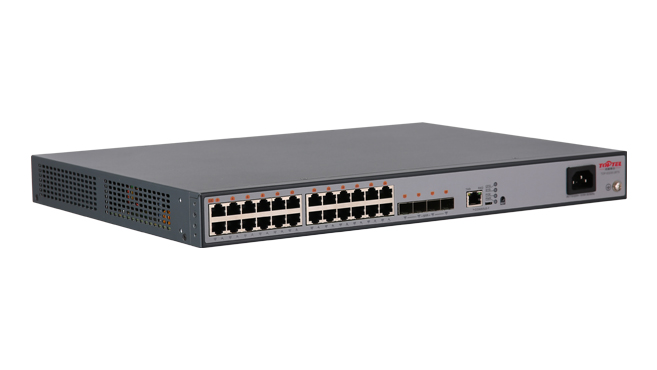
Usually the part of the network that directly faces users to connect or access the network is called the access layer, which is equivalent to the basic staff in the company's structure. Therefore, the access layer switch has the characteristics of low cost and high port density. The access layer provides users with the ability to access application systems in the local network segment, mainly to solve the needs of mutual access between neighboring users, and to provide sufficient bandwidth for these accesses.

The access layer should also be responsible for some user management functions ( Such as address authentication, user authentication, etc.), and user information collection (such as IP address, MAC address, access log, etc.). The difference between core layer/aggregation layer/access layer and leaf-spine topology Whether it is the core layer, the convergence layer or the access layer, all belong to a relatively traditional network structure. At present, the leaf-spine topology structure is more advanced.  
The difference between access layer switches, aggregation layer switches and core layer switches
1. Functional difference
 The main function of the core layer switch is for routing and high-speed forwarding, providing an optimized and reliable backbone transmission structure, so the core layer switch application has higher reliability and throughput. The convergence layer switch is the convergence point of multiple access layer switches. The function is to uniformly export the access nodes, and also do forwarding and routing. It must be able to handle all traffic from the access layer equipment and provide an uplink to the core layer. The function of the access layer switch is to connect end users to the network, so the access layer switch has the characteristics of low cost and high port density.
2. Performance difference
The core layer switch is a three-layer switch, high-speed forwarding, large-capacity interface bandwidth (such as 10 Gigabit interfaces), and large backplane processing capabilities, so its performance is higher than the aggregation layer switch and the access layer switch. The aggregation layer switch also has some routing functions, which can be a layer 2/layer 3 switch, and the access layer switch is a layer 2 switch. Therefore, compared with the access layer switch, the aggregation layer switch has higher performance, fewer ports and higher speed. . In short, the performance comparison results of these three types of switches are: core layer switches> aggregation layer switches> access layer switches.
3. Differences in usage scenarios
There are no fixed requirements for core layer switches, aggregation layer switches, and access layer switches. Which layer they are on mainly depends on the size of the network environment and the forwarding capabilities of the equipment, and not every network must have these three structures. Some Enterprises only have access layer switches and core layer switches. One of the purposes of this approach is to save costs.

Successful Case

New retail
With the popularity of new retail, people enjoy to buy the commodity from the 24 hours vending machine. Product origin and retail store data interconnection, intelligent transfer goods, virtual experience......
Intelligent Elevator
In recent years, elevator accident happens time by time. there are two main factors for this situation: 1. the lack of regular maintenance, 2,people know less about the principle of elevator construction......
Mobile WIFI
With the development of wireless communication industry, WiFi communication is gradually promoted to public places, including public mobile transportation vehicles, such as buses, tour bus, subway, cruise ship etc.......
Intelligent Bus Station
Being part of intelligent transport and smart city, smart bus station platform is a livelihood project benefit cctizen's daily life. an implement task. Electronic station boards at the bus stations display public vehicles arrival information and operation state in real time......
Intelligent distributed feeder automation
The smart power grid is moving toward intelligent distributed feeder automation (FA) to provide power supply stability, fast response to outages, running topology calculations, and fast fault location and isolation. Energy network must realize......
Secondary Water Supply Control
With the progress of urbanization, the current decentralized management mode of secondary water supply has been unable to meet the requirements for secondary water supply management, water quality and pressure, and service quality......
Intelligent Transportation
With the acceleration of urbanization, urban traffic pressure is increasingly intensified and traffic flow continues to rise, resulting in serious urban traffic congestion, frequent traffic accidents and traffic violations etc......
Smart Power Grid Monitoring
remote video monitoring system has been widely used in smart power grid monitoring system. The system acquire remote video data and dynamic environment data from transmission lines, towers at all levels and......
Meteorological Monitoring
The ground network of the traditional meteorological information system is built earlier, and the equipment performance is not good enough, the line speed is low, and the time is prolonged. It is difficult to meet the comprehensive data transmission requirements of automatic stations, sandstorms, radar etc.Satellite network coverage is small, low speed, and small stations can not directly communicate with each other, which limits the network function.
ATM Networking & Surveillance
In the banking system, most of the existing self-service devices (such as ATM terminals and self-service query terminals) are connected to the wired network. This wired access mode restrict the coverage of the self-service terminal......
Intelligent Charging Pile
Charging facilities mainly includes centralized charging station and distributed changing piles, scattered location and large number. In order to ensure user experience and operation efficiency, it is necessary to provide......
Self-service Terminal
With the popularity of self-service equipment such as vending machines, self ticketing equipment, payment terminals and so on, 24 hours unattended self-service terminal achieve significant business volumes......
Message Us